📌 Quick facts: A pool permit cost calculator gives you a working range, not a final quote. Building permits for a residential pool typically run between $300 and $2,000, or roughly 0.5% to 2% of total project cost. Flat-fee cities usually charge far less; formula-based cities usually charge more. Trade permits for electrical and gas work typically bill as separate line items. Your city's published fee schedule always beats any calculator.
A pool permit cost calculator works by taking three inputs, your city's fee method, your project value, and your pool's size, then producing a ballpark number you can budget around. As of November 2026, published municipal fee schedules still rely on three main methods: flat fees, valuation-based formulas, and unit charges. The catch is that no single online calculator knows your city's method. The real trick is learning how each method works so you can run the math yourself in ten minutes with your city's schedule open in another tab. This guide shows you exactly what to plug in, what the outputs mean, and where the hidden line items usually hide.
Table of Contents
- 1What a Pool Permit Cost Calculator Measures
- 2Three Calculator Types You'll See Online
- 3Flat-Fee Cities Show the Low End
- 4Valuation-Based Formulas Drive the High End
- 5Above-Ground Pools and the 24-Inch Rule
- 6Trade Permits: The Add-Ons Calculators Forget
- 7Plan Review, Inspections, and the Timeline
- 8Worked Example: Estimating a Mid-Range Inground Pool
- 9Where to Find Your City's Official Fee Schedule
- 10Budget Rules That Keep Your Number Honest
What a Pool Permit Cost Calculator Measures
Think of the calculator as a wrapper around your city's fee schedule. It does not set the price. It multiplies and adds the same numbers a permit technician would, just faster and with more room for error.
Three inputs matter most. First, the declared project value, because many cities charge a percentage of construction cost. Second, the pool's dimensions and volume, because some cities bill by gallons or square footage. Third, the scope of the work, because a shell with a concrete deck permits differently than a full package with heater, lighting, and automation.
What it leaves out matters too. A basic calculator rarely includes plan review surcharges, barrier inspection re-inspection fees, impact fees in fast-growing suburbs, or the trade permits for the pump circuit and gas heater. Those extras can add hundreds of dollars, sometimes more than the base building permit itself. When you run your own numbers, list them as separate rows instead of hoping one figure covers everything. A spreadsheet with six honest rows beats one tidy number every time.
If you want the deep background on how residential permit fees work in general, the state-by-state breakdown in our permit costs by state guide pairs well with this one.
Three Calculator Types You'll See Online
Not all tools multiply the same way, and knowing the type helps you spot a bad number fast.
Type one is the national average tool. You type a zip code and a pool size, and it returns one range for the whole country. Treat it as a vibe check, nothing more. It cannot know whether your city bills by gallon, by declared value, or by a flat rate, so its output can miss your real total by a wide margin in either direction.
Type two is the contractor-built estimator. Pool builders usually fold permitting into the project quote, and their tools reflect their own service area. That makes them accurate for their territory and useless outside it. The number they show may also bundle the permit with plan prep, which hides the government fee inside a service fee.
Type three is the spreadsheet you build from your city's actual schedule, and it's the only one worth trusting for a final budget. It takes maybe twenty minutes: find the schedule, copy the line items into rows, apply the formula to your declared value, and add the trade permits. Every row links to a printed number from a .gov page, so when the permit tech disagrees with your math, you can point at the row and ask which line changed.
Flat-Fee Cities Show the Low End
Some cities skip the math entirely and publish one number for a residential pool. Smaller municipalities often do this because their permit volume is low and staff time is the main cost. Two real examples from published schedules show how wide the spread can be.
Salem, Illinois lists swimming pools, temporary or permanent, at a $25 flat permit fee on its city permit fee page. A flat fee like that typically covers administration and one or two inspections, nothing fancy. At the other end of the scale, Miami's building permit fee schedule sets a fixed minimum rate for residential work under $2,500 in declared value, which means small pool-related jobs get billed at that floor rather than a percentage.
| Fee style | Typical range | Where you see it |
|---|---|---|
| Flat fee per pool | about $25 to a few hundred dollars | smaller cities, simpler forms |
| Percentage of declared value | roughly 0.5% to 2% of project cost | larger cities, full plan review |
| Unit charge | varies, sometimes per 1,000 gallons | utilities-driven jurisdictions |
Flat fees look cheap until you read the fine print. Some low flat amounts cover only the building portion, while electrical, plumbing, and fence permits bill separately. Before you celebrate a $25 number, confirm what it actually includes.
Valuation-Based Formulas Drive the High End
Larger building departments usually charge a percentage of declared construction value, and the percentages stack in tiers. The declared value is what you write on the application, and yes, staff can reject a number that looks too low for the work described.
San Diego's development services department publishes its fee schedule for construction permits, which shows how a big-city formula layers a base charge, tiered valuation increments, and small surcharges like a records fee collected at permit issuance. Jacksonville takes a different approach for pools: its city fee list bills swimming pools by volume, roughly $1 per 1,000 gallons, so a larger pool pays more than a smaller one even before plan review. Two cities, two entirely different calculators.
Run a quick sanity check with the canon range. If your pool package runs about $60,000 in declared value and your city charges in the neighborhood of 0.5% to 2% of project cost, your building permit alone lands somewhere between about $300 and $1,200. Add plan review, trade permits, and inspection surcharges, and the total drifts toward the upper end of the $300 to $2,000 band that covers most residential projects. If a calculator hands you a number outside that band, check whether it used the wrong method for your city.
Above-Ground Pools and the 24-Inch Rule
Depth decides more than any brand name does. The residential code exemption in IRC Section R105.2, work exempt from permit, carves out certain prefabricated pools for one- and two-family homes that are less than 24 inches deep. Those shallow, storable pools generally need no building permit at all.
Cross the 24-inch line and the picture flips. A typical steel-frame or resin above-ground pool with a filtration system usually triggers a permit in most jurisdictions, because the electrical bond, the pump circuit, and the barrier all need review. Some cities treat these pools with a lighter, cheaper permit category than inground construction, so the fee can be a fraction of the full package. Others lump everything together.
Before you buy that seasonal big-box pool, check two things: your city's depth threshold and whether your homeowners association has its own rules on top. Our guide on hot tub permits walks through the same logic, since portable spas sit in a similar gray zone.
Trade Permits: The Add-Ons Calculators Forget
The building permit is rarely the whole story. Pools drag three trades into the project, and each one usually pulls its own permit.
- Electrical: an electrical permit for the pump and lighting circuit typically runs $100 to $300, depending on the panel work involved. Bonding inspection is usually part of it.
- Gas: a gas line permit for a pool heater often adds $75 to $250, roughly, if your heater runs on natural gas or propane.
- Barrier and fence: a fence permit, where required separately, usually bills as its own small line item, and the barrier must meet your local height and gate rules.
Some cities roll these into a single pool permit. Many do not. When you phone the building department, ask one specific question: does the pool permit include electrical and gas, or do those bill separately? That single answer can swing your total by several hundred dollars. If your contractor pulls the trade permits, ask whether their quote shows the permit amounts or just a vague "permitting" line.
Plan Review, Inspections, and the Timeline
Plan review is the fee most calculators skip. Larger departments charge it as a separate percentage or flat amount, sometimes at submission, sometimes at issuance. On a straightforward residential pool, plan review typically adds days, not months, though busy season can stretch it.
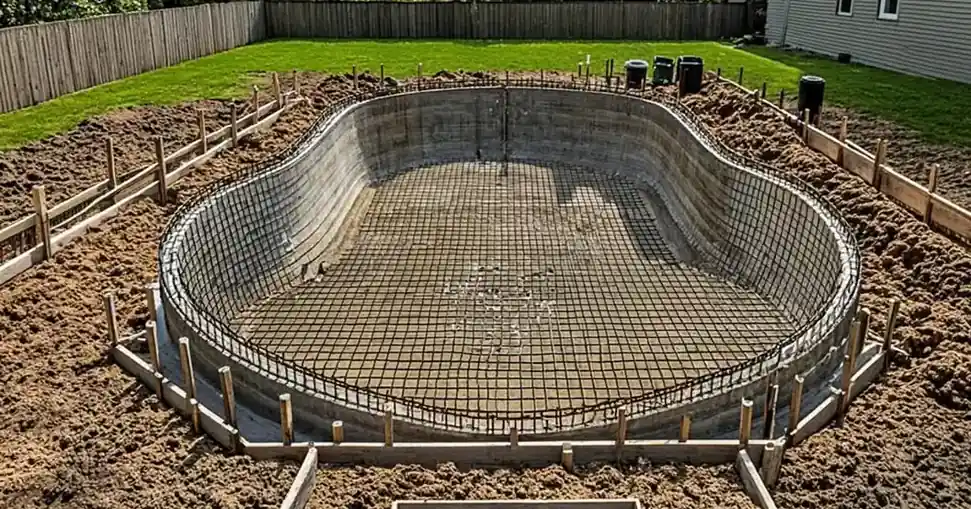
The inspection sequence usually runs like this: pre-gunite or pre-steel inspection, plumbing and electrical rough inspections, bonding check, then final barrier inspection before the pool fills. Miss a barrier detail, a gate latch height, an unclimbable decorative feature, and you may pay a re-inspection fee, often a modest flat amount. Budget for one re-inspection even if you never need it. Hope is not a budget strategy.
Timeline expectations, hedged honestly: small cities may turn a pool permit around in a few days. Mid-size cities usually take one to three weeks for a complete application. Major metros with heavy queues can run longer, especially from spring through early summer when everyone with a backyard decides to dig. Submit in February and you usually skip the worst of the line. Wait for the first warm weekend and you join it.
Completeness drives speed more than city size does. Applications get rejected for the same handful of reasons every time: a missing site plan with setbacks marked, no barrier detail drawing, an unsigned contractor authorization, or a declared value that looks wrong for the scope. Each correction bounces your application to the back of the queue. Spend an evening making the submittal package boring and complete, and you often save weeks.
Worked Example: Estimating a Mid-Range Inground Pool
Let's run the numbers for a realistic project. Say you're installing a 20 by 30 foot vinyl liner pool with a heater, deck lighting, and about 18,000 gallons of water, declared value around $55,000 in a city that uses valuation-based fees.
Step one, the building permit: at roughly 0.5% to 2% of declared value, that's about $275 to $1,100, which squares with the $300 to $2,000 band most homeowners see. Step two, plan review: call it a smaller percentage or flat fee, commonly a few hundred dollars at most on a project this size. Step three, the trades: the electrical permit at the typical $100 to $300 range for pump circuit work, plus a gas line permit at the usual $75 to $250 for the heater run. Step four, contingency: one re-inspection fee and a records surcharge, maybe a couple hundred dollars combined, depending on the city.
Add the middle of each range and you land near $900 to $1,400 in total permit spending. A flat-fee town could cut that to under $400 all-in. A tiered big-city formula could push past $2,000 if plan review and impact fees pile on. Same pool, three cities, three very different totals. That spread is exactly why the calculator input that matters most is your address.
Where to Find Your City's Official Fee Schedule
Skip the generic calculators for the final answer. Search your city's name plus "building permit fee schedule," and look for the .gov domain. Nearly every building department publishes its schedule as a PDF or a fee page, the same one the counter staff use.
Miami's fee schedule page is a good template for what to look for: declared value tiers, minimum charges, and notes about which work falls under each category. If your city's site buries the document, call the permit counter and ask them to email it. Ask two questions while you have them: which method applies to residential pools, and whether plan review bills separately. Write down the date and the staff member's name. Fee schedules change, and a dated note protects you if the number moves between your estimate and your application.
HOA rules sit on top of all of this, and they approve on their own clock. If you have an association, read our HOA pool installation guide before you submit anything to the city, because some associations want architectural approval first.
Budget Rules That Keep Your Number Honest
Three habits separate accurate pool permit budgets from wishful ones.
- Use the band, not a point. Building permits for typical residential work generally run $300 to $2,000, and pools sit squarely in that world. Anyone quoting you $50 for a full pool package is quoting the fence, not the pool.
- Separate the trades. The building permit, the electrical permit, and the gas line each carry their own fee, and pretending they're one number is how budgets blow up at the counter.
- Anchor to your own schedule. Comparisons help for sanity checks, but your city's published numbers are the only ones that count. For the broader context, our residential permit fees overview and our pool-specific pool permit cost guide fill in the state-level picture.
One more habit worth stealing from permit processors: recheck the schedule each January. Cities amend fee resolutions on fiscal cycles, and the number you saved last summer may be stale by the time you break ground. A two-minute check before you sign the pool contract keeps the budget you built on purpose instead of one you inherited from an old PDF.
Do that, and you don't need a fancy tool. Your pool permit cost calculator is the fee schedule, a calculator app, and twenty minutes of honest row-by-row math. The pool company sets the dig date. You'll already know what the paperwork costs.