Table of Contents
- 1The Short Answer
- 2Why the Curb Cut Drives the Answer
- 3Permit Rules by Project Type
- 4City vs. County vs. State Roads
- 5What the Application Asks For
- 6Gravel Driveways: The Rural Special Case
- 7What a Driveway Permit Costs
- 8If You Skip the Permit
- 9A Quick Decision Path
- 10Questions Homeowners Ask About Driveway Permits
- 11Do I need a permit to widen my existing driveway?
- 12Is a permit required for a gravel driveway?
- 13How much does a residential driveway permit cost?
- 14Can I pour my own driveway without a contractor?
- 15What happens if I pour a driveway without a permit?
- 16Do I need a separate permit for the culvert on a rural driveway?
The Short Answer
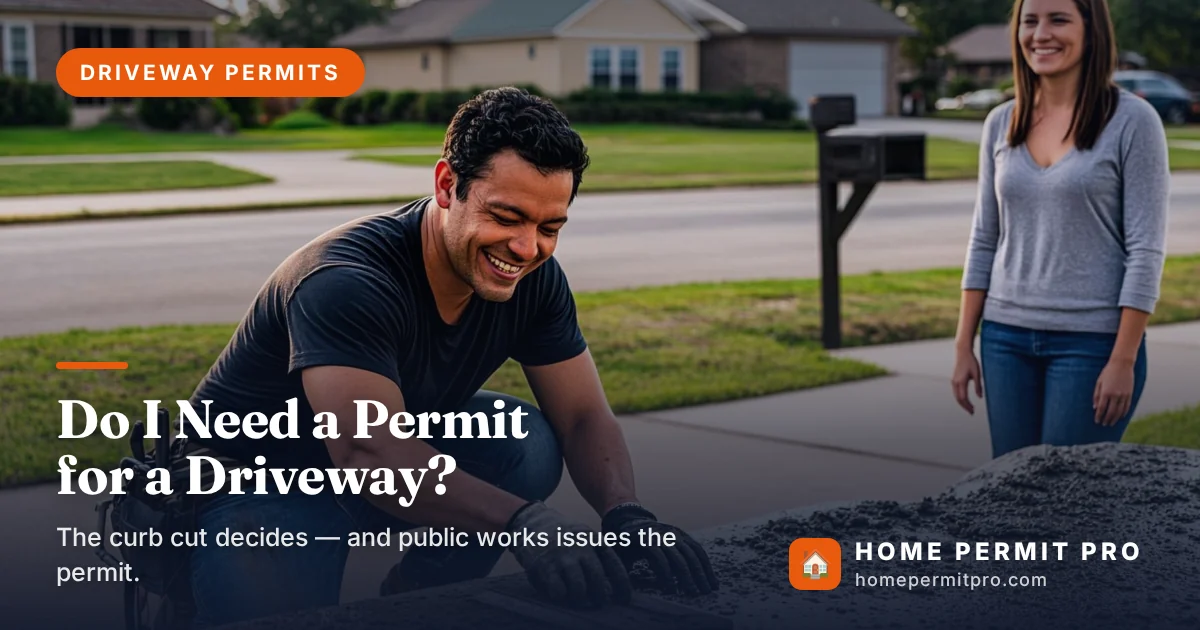
Most of the time, yes — a new driveway needs some kind of permit, because nearly every driveway connects to a public street and that connection is regulated. The permit is often issued by the public-works or transportation department rather than the building department, especially when a curb cut, apron, or culvert is involved. What varies is the paperwork: some cities fold the driveway into a single right-of-way permit, some want a zoning review on top, and rural counties mostly care about the drainage where your drive meets the road.
The projects that reliably need approval: new driveways with a curb cut, any widening that changes the apron, driveways crossing a sidewalk, work that disturbs the right-of-way, and anything with a culvert or drainage connection. The projects that usually don't: resurfacing an existing driveway in place, sealing, and minor repairs that don't change dimensions. Between those poles sit gravel drives and pad widenings, where the answer is genuinely local.
📌 Quick facts: The curb cut is usually the regulated piece, not the driveway surface. Portland requires permits for new or replaced curb cuts even when the driveway itself is simple. Seattle treats a curb cut permit as its own permit type. On state highways, the state DOT issues the access permit — not your city.
Why the Curb Cut Drives the Answer
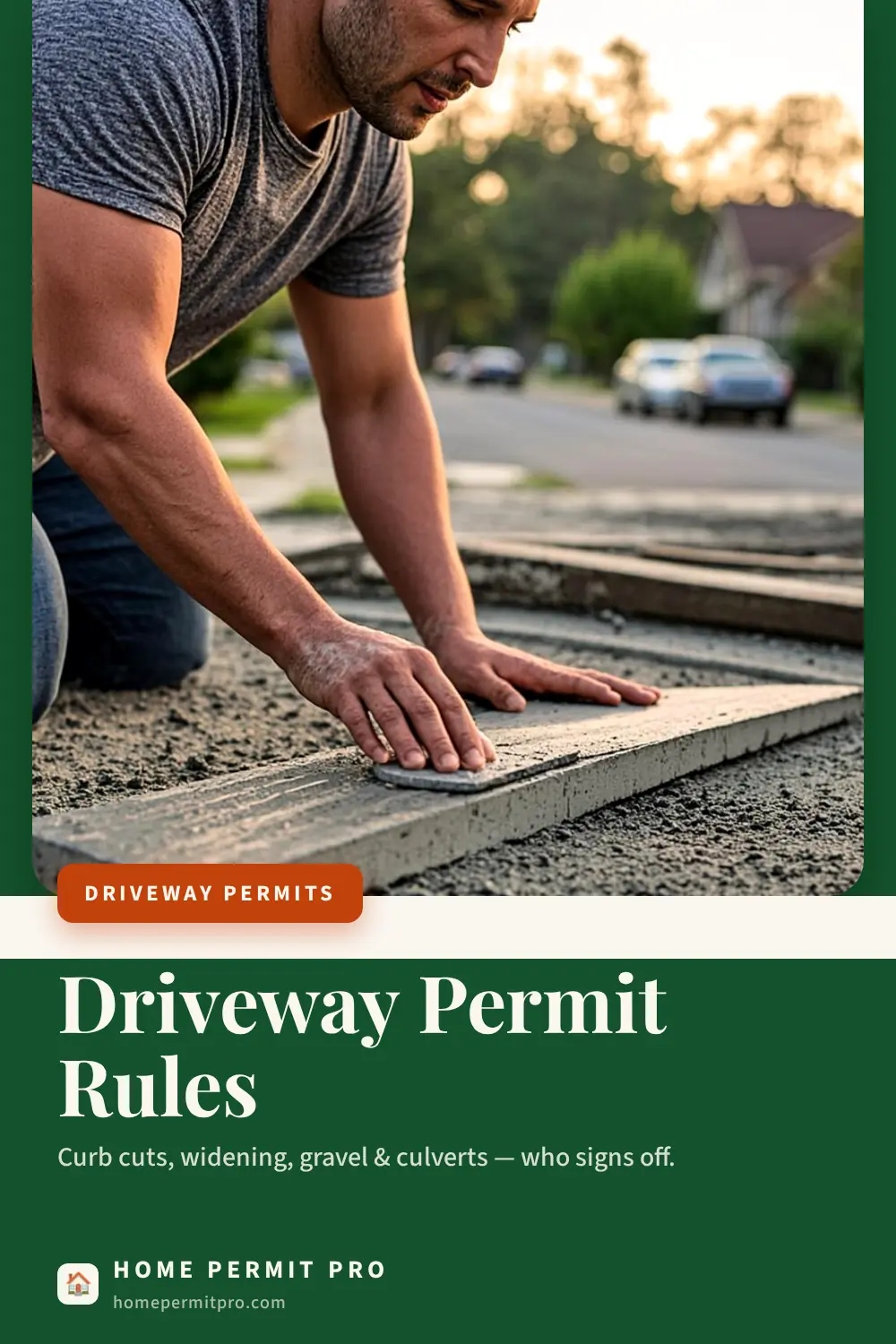
Your driveway has two lives: the part on your property and the part that crosses public infrastructure. The sidewalk, the curb, the tree lawn, and the roadway itself belong to the city, and cutting into them is a right-of-way activity no city lets you do unannounced. That's why the permit question so often routes through public works: the apron and curb cut are public assets, and the city wants its own spec — concrete thickness, slope, reinforcement — applied by a bonded contractor.
The second reason is engineering. Every new curb cut removes a piece of curb parking, adds a vehicle conflict point at the sidewalk, and changes street drainage. Cities manage all three through spacing rules, width caps, and sometimes visibility requirements near corners. A permit application is how they check that your proposed opening doesn't sit too close to an intersection or a neighbor's apron.
Practically, this means the fastest way to size up your project is to ask one question: does the work touch the right-of-way? If yes — new curb cut, apron replacement, sidewalk damage risk — expect at least one permit and possibly two. If the work stays entirely on your side of the property line, the building or zoning side of the house takes over, and the thresholds get friendlier.
Permit Rules by Project Type
| Project | Permit usually required? | What the review checks |
|---|---|---|
| New driveway with new curb cut | Yes — right-of-way/street permit | Curb cut spacing, width caps, sidewalk protection, spec of apron |
| Widening an existing driveway | Often yes | New apron dimensions, drainage, zoning width limits |
| Resurfacing in place (same footprint) | Usually no | — |
| Gravel driveway, rural, new access to county road | Yes — access/culvert permit | Culvert size, ditch drainage, sight distance |
| Gravel patch inside the lot, no road connection change | Often no | Zoning definition of driveway still applies |
| Driveway on a state highway | Yes — state DOT access permit | Sight distance, spacing, drainage to the highway ditch |
| Adding a turnabout or extra parking pad | Sometimes | Zoning setbacks and lot coverage more than right-of-way |
The table's pattern is worth internalizing: connection to the public street is the trigger, and dimensions are the review. A same-footprint overlay of an existing legal driveway rarely registers with anyone; change the opening, the width, or the drainage, and the paperwork reappears. Cities differ in how they bundle the review — some issue one right-of-way permit covering curb cut and apron, others split the work across a street-opening permit and a zoning check — which is why it pays to name your project precisely when you call: "new curb cut and apron for a residential driveway" gets you to the right desk faster than "driveway work."
City vs. County vs. State Roads
Who issues your driveway permit depends on who owns the road, and that surprises people more than anything else on this topic. A city street puts public works in charge. An unincorporated county road shifts you to the county engineer, where the permit is usually called an access or entrance permit and centers on the culvert. If your driveway meets a state route, the state department of transportation issues the access permit — New York's DOT, for example, publishes its driveway and highway work permit programs on its site, and no local permit substitutes for it.
The practical effect: on a corner where a county road meets a state highway, you can need two access permits for one driveway. Rural homeowners discover this most often, because state routes run through unincorporated land everywhere. Before you price the project, identify the road's owner — the GIS layer on your county's site usually says — and call that agency first. Pricing a culvert from a private contractor without the county's size requirement is how a $400 pipe becomes a $2,000 re-dig.
What the Application Asks For
Right-of-way driveway applications are simpler than building permits but not casual. Expect to provide:
- A site sketch or survey showing property lines, the proposed apron width, and distances to intersections and neighboring cuts.
- Drainage plan — how water moves across the drive, whether a culvert is needed, and its diameter.
- Contractor and insurance info for anyone working in the right-of-way; many cities require bonding before the curb is cut.
- Traffic control plan for longer jobs — cones and signage on busier streets.
Zoning-side review adds width and setback checks — whether the widened surface respects side yard rules and the code's definition of a driveway. Both reviews run in parallel in well-run cities; in others, public works and zoning hand you off. Either way, a drawing that answers both sets of questions passes faster than two half-documents. Our guide to driveway setback rules covers the zoning half in depth.
Gravel Driveways: The Rural Special Case
Out where unpaved drives are normal, the permit conversation shrinks to one component: where the drive meets the public road. Counties issue entrance permits to control the culvert — its diameter, its invert elevation, and the headwall that keeps the ditch working. Skip the permit and install a too-small pipe, and the road ditch backs up during the next storm, which is how an unpermitted culvert becomes a county crew pulling it out and billing you.
Inside the property line, gravel is mostly unregulated in rural zones, though the zoning definition of driveway can still matter for setbacks and lot coverage. Suburban and urban lots are different: there, a "gravel driveway" reads as a parking surface, and cities that cap impervious coverage treat compacted gravel as impervious anyway. When the definition is ambiguous, get the planner's interpretation in writing — the same advice we give for front yard setback questions, which gravel pads love to raise.
What a Driveway Permit Costs
Right-of-way permits are fee-banded by scope: curb cut permits in mid-size cities commonly run from around $100 to a few hundred dollars, with inspection and restoration deposits on top in jurisdictions that bond the work. Rural access permits are often cheaper — flat fees in the tens-to-hundreds range — while state DOT access permits scale with the highway's classification. The number that surprises homeowners isn't the permit; it's the sidewalk restoration deposit, which the city holds until the apron and any disturbed walkway pass inspection. All of this scales with the valuation-based fee families described in our state permit cost comparison and the breakdown of typical residential fees.
If You Skip the Permit
Unpermitted driveway work gets discovered three ways: a neighbor complaint, a city inspector noticing fresh concrete in the right-of-way during another job, or a problem at sale when the survey shows an apron that doesn't match city records. The remedies scale with the damage — after-the-fact permits and fees for compliant work, removal and restoration for work that violates spacing, width, or drainage rules.
Culverts are the highest-stakes version, because a bad culvert is a flood risk to the road itself, and counties defend their ditches aggressively. The consequences of unpermitted work generally — fines, removal, trouble at resale — follow the pattern we document in what happens if you build without a permit, and driveways are one of the easiest violations to spot from the street.
A Quick Decision Path
- Identify the road owner — city, county, or state. That sets the agency and the permit name.
- Ask if the work changes the connection — new or wider curb cut, new culvert, apron replacement. Changes mean permits; overlays usually don't.
- Check zoning dimensions — width caps, side setbacks, lot coverage — before finalizing the layout.
- Apply with one complete sketch that answers right-of-way and zoning questions at once.
Questions Homeowners Ask About Driveway Permits
Do I need a permit to widen my existing driveway?
Usually yes, because widening almost always changes the apron or curb cut, and that's right-of-way work. Some cities treat a pure on-property widening as a zoning-only question, but any change to the street opening needs the street permit. Ask public works before the saw cuts — the answer also determines whether a contractor bond or sidewalk repair deposit applies.
Is a permit required for a gravel driveway?
Rural properties usually need an access or culvert permit where the drive meets the county road, even when the drive itself is unregulated. Inside city limits, a gravel surface generally counts as a driveway under zoning definitions, so the same curb cut and width rules apply as concrete. The material rarely changes the permit answer; the connection to the road does.
How much does a residential driveway permit cost?
Curb cut and right-of-way permits commonly run from around $100 to a few hundred dollars depending on the city, with rural access permits often cheaper and state DOT permits scaling with the road's classification. Deposits for sidewalk restoration can be larger than the fee itself, refunded after inspection. Your public works department's fee schedule lists the exact numbers — cities like Pittsburgh publish theirs alongside a dedicated curb cut application.
Can I pour my own driveway without a contractor?
In many jurisdictions yes for the on-property portion, but right-of-way work often requires a bonded contractor — the city wants someone accountable for restoring the curb and sidewalk. Homeowner-poured aprons that fail the public-works spec can be ordered rebuilt. Check both the permit rules and the contractor requirement before deciding.
What happens if I pour a driveway without a permit?
Expect an after-the-fact permit at a penalty multiple if the work meets standards, and removal or rebuild orders if it violates curb cut spacing, width caps, or drainage rules. Unpermitted aprons also complicate sidewalk liability — if the city repairs the curb later, non-standard work can be torn out at the owner's cost. The fines and rework always exceed the permit fee.
Do I need a separate permit for the culvert on a rural driveway?
The culvert usually is the permit. County entrance permits specify pipe diameter, elevation, and installation details because an undersized culvert backs up the road ditch during storms. Install the county-spec pipe and the inspection is quick; install your own pipe first and you may be paying to remove it.
✅ Key takeaway: New driveways and any change to the street connection need a permit — usually from public works or the road owner, not the building department. Resurfacing in place rarely does. Get the road owner, the culvert spec, and the zoning width limits straight before the concrete truck books, and the project stays a weekend job instead of a code case.