📌 Quick facts: Roof permit fees in Florida vary by city and by county, and most single-family re-roofs run from modest base fees up into the $300-$2,000 spread that full building permits typically take. Miami bills residential permits per $100 of estimated construction value. Jacksonville stacks several separate line items on one permit. Miami-Dade notes that House Bill 803 exemptions began July 1, 2026 for some small home improvement work, though roof replacement usually still needs a permit. Miami-Dade and Broward follow extra-strict HVHZ roofing rules.
Roof permit fees in Florida typically range from a small flat fee to a few hundred dollars for a straightforward re-roof, and they climb when your city calculates the permit as a share of construction value. There is no statewide fee. Your building department sets it, and two neighbors across a city line can owe very different amounts for the same shingle job.
What makes Florida different is not the fee itself. It is what sits underneath: a statewide building code with some of the toughest roofing rules in the country, a product-approval system that governs what goes on your roof deck, and two southeast counties, Miami-Dade and Broward, that enforce an even stricter high-velocity hurricane zone standard. This guide breaks down the fee mechanics, the real posted structures, and the path from application to final inspection.
Table of Contents
- 1What Roof Permit Fees in Florida Actually Cover
- 2When Florida Requires a Roof Permit
- 3How Florida Cities Calculate Roof Permit Fees
- 4Real Fee Structures From Posted Florida Schedules
- 5The HVHZ Factor: Miami-Dade and Broward Roof Rules
- 6Product Approval: The Paperwork Behind Your Shingles
- 7What Else Stacks on the Fee
- 8How to Apply and How Long It Takes
- 9Roofing Without a Permit in Florida
- 10Quick Checklist Before the Roofing Crew Arrives
What Roof Permit Fees in Florida Actually Cover
A roof permit pays for two things: plan review and inspection. The reviewer checks that the roofing system, underlayment, and attachment method match the Florida Building Code and the manufacturer's approved installation. The inspector verifies the work at set stages, often at the tear-off or nail-check stage and again at completion.
The fee does not usually change with your shingle color or brand. It changes with project value, roof size, or the fee formula your jurisdiction uses. Cities that bill per $100 of construction value typically care about the number on your contractor's estimate, while flat-fee cities usually charge one set line item for most residential re-roofs and add surcharges on top.
One thing the permit is not: optional. Roof replacement over an occupied structure is permitted work essentially everywhere in Florida, and skipping it creates problems that show up long after the crew leaves. Our guide on roof replacement permit costs by state shows how Florida's approach compares with the rest of the country.
When Florida Requires a Roof Permit
Full replacement needs a permit, always. The nuance lives in the middle ground. Small repairs and patching are often treated as exempt maintenance in some jurisdictions, while larger recover jobs, where new material goes over an existing roof, draw scrutiny because Florida's code limits how many roof layers you can bury and how existing damage gets handled.
The boundary that trips homeowners is scale. A few lifted shingles after a storm is usually a repair. Reroofing an entire slope, changing the roof covering type, or repairing more than a small share of a roof section can pull the project into full code-upgrade territory under the state's existing-building rules. The permit-exemption list in the International Residential Code, which Florida's residential code builds on, covers small finish work and never a full roof covering, so a replacement always lands on the permitted side.
Miami-Dade maintains a permit exemptions page that notes House Bill 803 exemptions for certain small home improvement projects beginning July 1, 2026, and Hillsborough County publishes its own work-exempt list. Roofing rarely appears on exemption lists, so treat any exemption claim with caution and get it in writing from the counter.
How Florida Cities Calculate Roof Permit Fees
Florida cities use two main formulas. Value-based cities charge a rate per $100 of estimated construction cost, which ties your fee directly to the project value your contractor declares. Flat-fee cities post a set number for residential roofing or for building permits generally, which keeps a re-roof cheap relative to a new addition.
The City of Miami fee schedule shows the value-based model plainly: residential permit fees are billed per $100 of estimated construction, with a distinct fee tier for residential improvements estimated under $2,500. A roof replacement declared at $15,000 is billed in those increments, so the estimate your roofer writes down literally sets the fee.
Jacksonville shows the stacked model. Its city fee list lays out a building inspection division permit fee plus separate resource management, landscape, and development services line items, with some calculated as percentages of the base. One roofing permit, several rows on the receipt. If your contractor quotes a permit number that looks too small, ask whether it includes the surcharge rows.
For scale: a full residential building permit in Florida generally runs $300-$2,000, about 0.5-2% of the project's value, and a re-roof carrying structural work, deck repairs, or trade permits for skylights and solar tends to sit in the middle of that band. Plain shingle-over-plywood jobs often land lower, though the exact number belongs to your city's current schedule.
Real Fee Structures From Posted Florida Schedules
Posted schedules make the formulas concrete even where the dollar figure depends on your declared project value. The City of Miami fee schedule and the Jacksonville city fee list are the two public examples worth reading side by side before you compare bids.
| Jurisdiction | Fee model | What the posted schedule shows |
|---|---|---|
| City of Miami | Value-based | Residential fees billed per $100 of estimated construction, with a floor tier under $2,500 |
| Jacksonville | Stacked fee lines | Building inspection fee plus resource management, landscape, and development services rows on one list |
| Hillsborough County | Exempt-work list | Publishes the categories of work that skip permits entirely, roofing generally not among them |
| Miami-Dade County | Exemption update | Notes HB 803 exemptions for some small home improvement projects beginning July 1, 2026 |
| Statewide pattern | Full permit band | $300-$2,000, i.e. about 0.5-2% of what the project totals, for structural-scale permits |
Treat the table as a map of formulas, not a price list. Your city's current sheet is the only figure that gets billed, and fee schedules shift with budget cycles. Searching "[your city] roof permit fee" typically surfaces the PDF in one click; the building department confirms figures by phone faster than a lunch break.
The HVHZ Factor: Miami-Dade and Broward Roof Rules
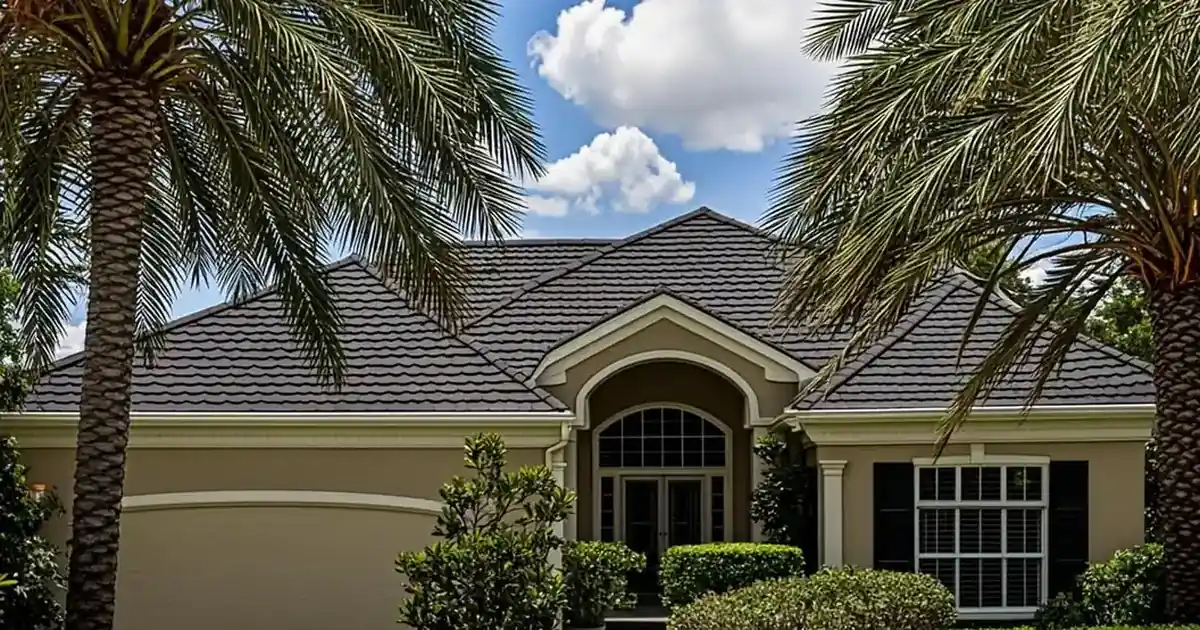
If your roof is in Miami-Dade or Broward County, you are inside the high-velocity hurricane zone, the strictest roofing jurisdiction in the United States. HVHZ standards govern how roof systems are tested, fastened, and sealed, and the counties run their own approval processes for roofing products on top of the state system.
Two practical consequences reach your wallet. First, product choice narrows, because the materials must carry approvals valid for HVHZ use, which can raise material cost even when the permit fee itself is ordinary. Second, inspections run deeper, with additional check stages during and after installation. Neither is a reason to worry; it is just budgeting with eyes open. Our Florida building permits walkthrough covers how the state system layers together.
Everywhere else in Florida, wind-zone requirements still shape the job. Coastal counties along the Atlantic and Gulf tend to require enhanced underlayment and attachment details that inland counties do not. The permit reviewer is the one who catches a spec that does not meet the local wind zone, so an experienced local roofer is worth their bid premium.
Product Approval: The Paperwork Behind Your Shingles
Florida runs a statewide product-approval system for construction materials, and roofing products live at the center of it. Shingles, tile, metal panels, and underlayments need either a state product approval or a county-level notice of acceptance before they can be installed. Your roofing permit application usually references the approved product and its installation method.
For homeowners this is mostly invisible: a licensed contractor pulls the paperwork. Where it bites is with out-of-state suppliers or cut-rate bids. Material that is not approved for Florida use fails plan review, and the permit you paid for stalls until the spec changes. Ask your contractor to name the approved product on the permit application, and keep a copy with your closing documents.
The same logic applies to deck repairs under the roof. Rotting plywood discovered at tear-off usually needs a repair permit or a scope note added to the existing one. Good contractors call it in; bad ones plywood-over it and hope the inspector is in a hurry. That gamble costs more than the permit ever did. Homeowners comparing full project budgets can see where roofing sits in the state-by-state permit cost guide.
What Else Stacks on the Fee
Beyond the base permit, several line items quietly appear. Re-inspection fees show up when a crew fails an inspection and the office sends someone back. Impact or service fees attach in some cities to fund plan review operations. Trade permits add on when the job includes electrical for skylights, solar-ready flashing, or plumbing vents that get reworked.
Timing costs money too. Hurricane season compresses everything: after a named storm, roofing permits spike, inspection queues lengthen, and emergency repair rules sometimes allow temporary work with expedited follow-up permits. Homeowners who file before the storm season starts typically pay the same fee and get the faster calendar. Our guide on what residential permit fees generally include helps you read the full invoice line by line.
HOA approval is the sneaky one. Many Florida subdivisions require architectural review of roofing color and material before the city permit matters, and the HOA clock runs on its own schedule with no fee cap. Start that letterhead conversation the same week you file, or your approved permit will sit idle while the shingles wait on a committee.
How to Apply and How Long It Takes
Most Florida roofing applications go through the contractor, and the packet is short: the application, the roofing system specification with product approval numbers, and the project value. Many cities accept online submittals, and some offer over-the-counter review for straightforward residential re-roofs.
- Confirm your city or county fee schedule and which formula it uses.
- Get the product approval or NOA numbers from your roofing contractor.
- Declare project value accurately, since value-based fees bill off it.
- Ask which inspection stages apply: tear-off, nail check, mid-roof, final.
- File HOA architectural approval in parallel, not after.
Timelines vary with season and city. Ordinary re-roof permits usually clear within a few business days to a couple of weeks; post-storm surges can stretch those queues considerably. Schedule the final inspection before the crew demobilizes, because a closed permit is what protects you at resale.
Roofing Without a Permit in Florida
The enforcement machinery is real. A neighbor's complaint, a insurance adjuster's file, or a code inspector driving past a dumpster can trigger a stop-work notice, and jurisdictions commonly bill investigation or doubled fees when work started without a permit. An unpermitted roof also complicates windstorm insurance, because carriers increasingly ask for permit records on older roofs before writing or renewing coverage.
Resale is where the bill usually arrives. Closing due diligence in Florida routinely includes permit history on the roof, and an unpermitted replacement can force a retroactive permit, an engineer's letter, or a price concession. Run the numbers honestly: the permit fee is the cheapest line on the whole roofing project — the one that keeps the next thirty years of that roof defensible.
Quick Checklist Before the Roofing Crew Arrives
Run this list the week before material delivery. One phone call and one folder of paper.
- Confirm the current roof permit fee and formula on your city's posted schedule.
- Verify the roofing products carry valid Florida approvals for your wind zone.
- Check whether partial-repair thresholds pull your job into a full code upgrade.
- Book inspection stages and confirm who calls them in.
- Get HOA approval in writing if your subdivision has covenants.
- File the final inspection sign-off alongside your house records for insurance and resale.
Florida's roofing rules look intimidating from the outside, but they follow a pattern: one statewide code, one product-approval system, and a local fee schedule that decides what you pay. Learn those three pieces and a re-roof becomes a scheduling exercise instead of a surprise invoice. Driveways and roofs are the two projects Florida permits most alike in spirit; see the same logic on the ground in our Ohio driveway permit cost guide or closer to home in the Florida driveway permit guide.